Naomi Pauling
Therapy
Emotions – part 1: What are emotions, and how do we experience and interpret them?
People are, for the most part, pleasure-seeking and pain-avoidant. We aim to experience more of the so-called “positive” emotions, like happiness, excitement, and love, and less of the “negative” emotions, like anger, sadness, or fear.
We value, seek out, and share “positive” feelings, whereas we tend to try to suppress, criticise, and medicate “negative” feelings.
Is there really such a thing as positive and negative emotions?
I believe the use of the terms “positive” and “negative” can be unhelpful when talking about emotions.
It predisposes us to want only the positive ones, and to dread and try to avoid the negative ones. The problem with this is that we can’t actually avoid or prevent all “negative” feelings. So we put pressure on ourselves to do the impossible, and when we are unsuccessful, those “negative” feelings can be more distressing than they perhaps otherwise would have been.
Because emotions are a physical and psychological response to internal or external stimuli, we often can’t change how we feel. But we can change our relationship with our emotions, which can change how we experience them.
Emotions in general have tended to be vilified in our society. We’re led to believe we should trust our thoughts and reasoning, rather than our feelings, which are seen as irrational, intrusive, and perplexing.
But all emotions serve a purpose, even the unpleasant ones. Learning to accept and understand our feelings can help with developing self-awareness, decision-making, and communicating and connecting with others.
At times, I think emotions can even give a more accurate sense of what’s going on than our thoughts.
For instance, when I feel lonely, I have thoughts that I’m unloved and unworthy of love, that no one really likes me, they only pretend to do so because they pity me, and so on. If I pay attention to my thoughts and believe them, I withdraw and further isolate myself. On the other hand, if I pay attention to the feeling of loneliness, and recognise it for what it is, I understand that the feeling is there to let me know that my need for social interaction and connection is not being sufficiently met. This encourages me to get in touch with friends and family, and ensure my needs are met.
Understanding our feelings and what they are trying to tell us helps us to regulate them.
Emotion regulation refers to the ability to influence the emotions we have, when we have them, and how we experience or express them.
In the above example, I am regulating my feeling of loneliness by interpreting it as a sign that I need connection. In so doing, I reduce the intensity and duration of the feeling, and I prevent it from spiralling into other unpleasant feelings like self-loathing and helplessness.
So when are emotions harmful?
Emotions can be harmful when they are the wrong intensity, duration, frequency, or type for a particular situation.
They can also be harmful when they maladaptively influence our thinking and behaviour – like my feeling of loneliness when it influences me to isolate myself and think of myself as undeserving of connection.
Starting to develop an understanding of your emotions
The first part of starting to use your emotions effectively is to develop your ability to recognise what you’re feeling.
Some people find this easier than others, but it’s a skill that everyone can learn, and through practice it gets easier and becomes a habit.
This is about developing your emotional intelligence.
Practice checking-in with yourself: How do I feel?
I do this not just when I’m feeling emotional, but habitually throughout my day. I check-in on my way to and back from work, before bed, and sometimes between tasks (particularly anything that demands emotional or mental effort).
When you check-in, try to notice all your feelings; the strong and the weak ones, the pleasant and the unpleasant ones.
Now ask yourself: How do I know I’m feeling like this?
This is really important, because it will help you to really understand how your emotions feel, how you relate to them, and how they affect you.
What activated the feeling? What happened just before I started feeling like this?
What physical symptoms tell me that I’m feeling this emotion? Where do I feel the emotion in my body?
What thoughts are linked with this feeling?
What do I do when I’m feeling like this? Do I have any urges or habitual reactions?
If you struggle to describe how you feel, as many people do, not to worry!
This doesn’t have to stop you from noticing how you feel physically, what you’re thinking, or what you’re doing.
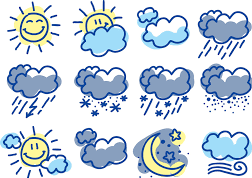
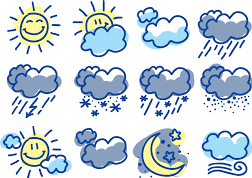
It can be helpful to use a tool like the weather to help you describe how you’re feeling.
For example, if I say “I’m feeling like clear blue sky with energy in the air, like when there’s a lightning storm brewing.” It can translate as feeling good, but perhaps with some excitement, apprehension or anxiety starting.
Or if I say “I’m feeling like a dark, cold, cloudy day with drizzle and strong gusts of wind” It can translate as feeling low, dark and unsettled. You get the gist.
The Mood Meter is also a helpful tool to start putting words to how you feel. It was developed by the Yale Centre for Emotional Intelligence as a tool to help students develop their emotional intelligence. It breaks emotions down into 4 quadrants:
- High energy – unpleasant emotions in red
- High energy – pleasant emotions in yellow
- Low energy – unpleasant emotions in blue
- Low energy – pleasant emotions in green
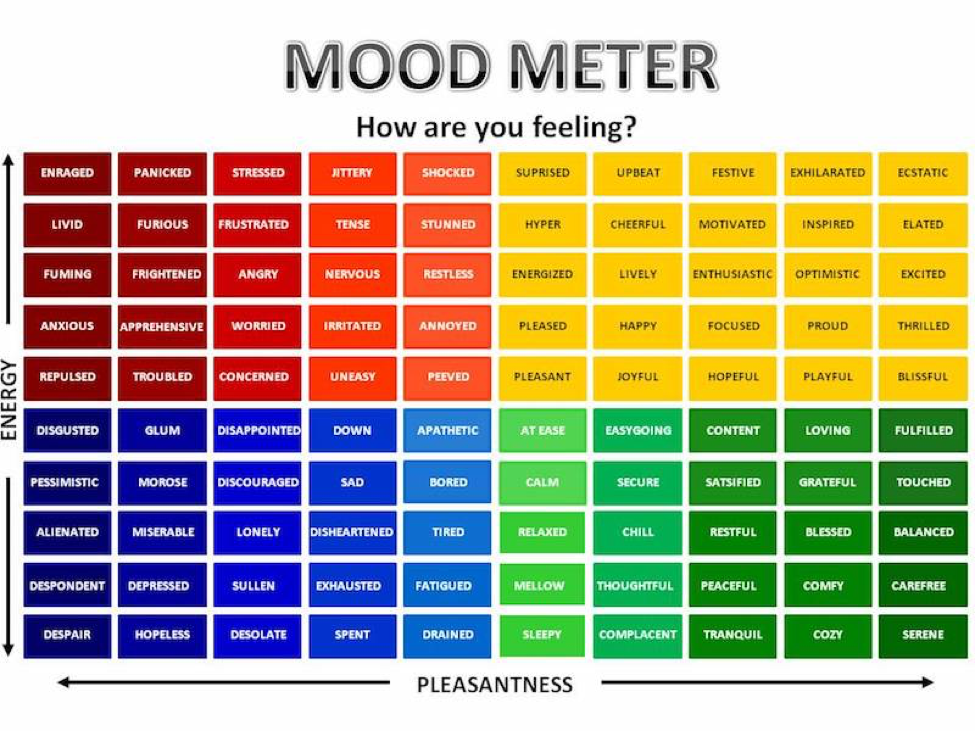
When checking-in, you can rate your energy on a scale of -5 to 5 and how pleasant you feel from -5 to 5. This will give you an indication of which quadrant you are in.
Check out this video from the YCEI for more information on using this tool: https://vimeo.com/52622350
There are also several apps, including one developed by YCEI, to help you develop your emotional awareness.
To summarise:
- Both pleasant and unpleasant emotions serve a purpose
- Understanding our emotions can help us to develop self-awareness, regulate our emotions, make decisions, and communicate and connect with others
- Forming a habit of checking-in with ourselves can help us to better understand our emotions, how they affect us, and how we relate to them
Read Emotions – part 2 for more information on what influences our emotions, the purposes they serve, and how to use them to communicate and connect with others, and to better understand our psychological needs.
 Naomi Pauling
Pingback: Emotions – part 2: Their influences, purposes, and uses – Pauling Coaching